Interesting facts about content created by artificial intelligence: how to tell what's real and what was created by AI?
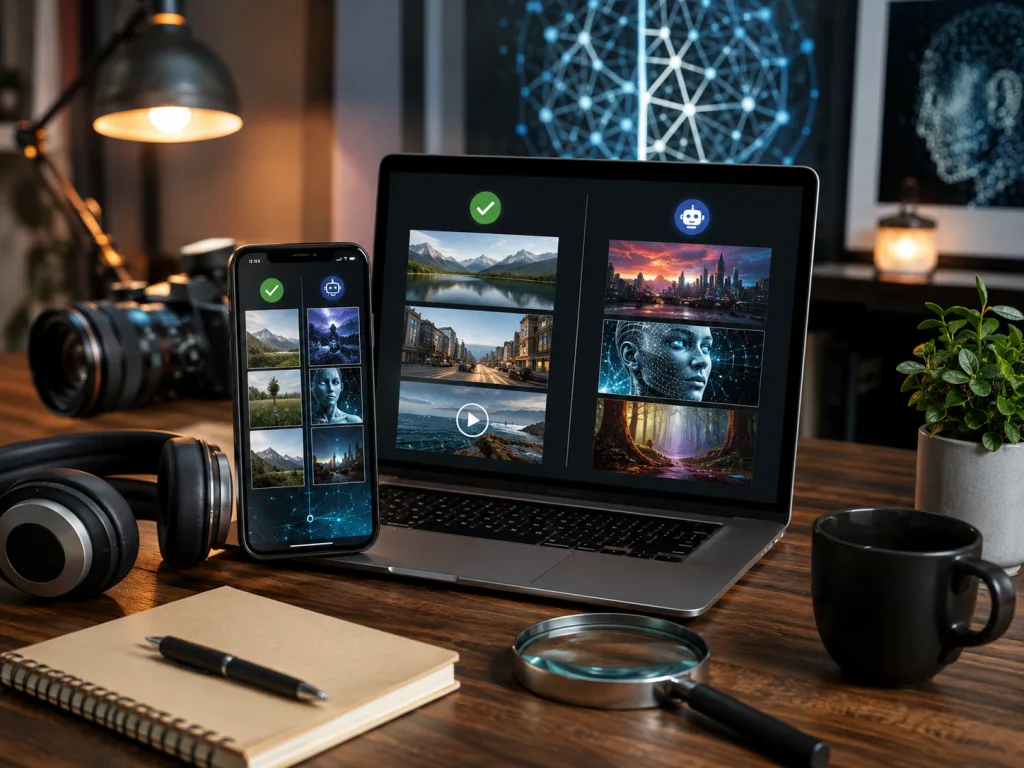
Artificial intelligence has changed the way texts, images, videos, voices, and music are produced. Today, a person can generate a realistic image in seconds, create a professional-looking video, simulate voices, write articles, assemble presentations, and edit photos with just a few commands. This has opened up many creative possibilities, but it has also brought an increasingly common question: how to tell what is real and what was created by AI?
The answer isn't simple. Some AI-generated content still has visible flaws, but other content is so convincing that it easily deceives. Therefore, identifying AI requires a mix of observation, source verification, use of tools, and critical thinking.
In this article, you will discover interesting facts about AI-generated content and learn signs that help differentiate artificial creations from real records.
AI content is becoming increasingly realistic.
Initially, AI-generated images were easier to identify. Hands with strange fingers, distorted faces, nonsensical text, and confusing backgrounds gave away their artificial origin. Today, these errors can still occur, but they are less obvious.
Modern tools can create images with natural lighting, realistic expressions, detailed textures, and very convincing scenes. The same applies to videos, audios, and texts. Cloned voices can mimic intonation, pauses, and emotion. Texts can appear to be written by real people. Videos can simulate statements from someone who never said them.
Therefore, relying solely on the appearance of content is no longer sufficient. The more advanced the technology, the more important it becomes to verify context, origin, and intent.
AI-generated images may contain minor errors.
Despite advancements, AI-generated images can still exhibit strange features. Hands, fingers, teeth, glasses, earrings, reflections, shadows, and background text remain areas where errors frequently occur.
A face may appear perfect, but the reflection in the mirror may be wrong. A person may be wearing a different earring in each ear for no reason. A license plate may have scrambled letters. One object may subtly merge with another.
These details alone don't prove that the image was created by AI, but they are warning signs. When something looks too realistic and, at the same time, has small visual inconsistencies, it's worth investigating further.
Fake videos are harder to spot.
Videos generated or manipulated by AI, popularly known as deepfakes, are even more concerning. They can show people saying or doing things that never happened.
In the past, it was common to notice flaws in blinking, out-of-sync mouth movements, or strange movements. Today, many videos correct a good portion of these problems. Still, some signs may appear: inconsistent lighting on the face, unnatural movements, incorrect shadows, slightly artificial audio, or expressions that don't match the speech.
The UK government highlighted in 2026 that deepfake detection technologies are being adopted by companies and governments for fraud prevention, brand protection, identity verification, and combating disinformation. This shows that the problem has ceased to be merely a technological curiosity and has become a real security concern.
Artificial voices can be deceiving.
Voice cloning is one of the most sensitive areas. With just a few seconds or minutes of recording, some tools can create audio that sounds like a real person's voice. This can be used in entertainment, voice acting, and accessibility, but also in scams.
An audio message asking for money, a supposedly urgent message from a family member, or a statement attributed to a public figure may be fake. Therefore, when you receive an unexpected voice message with a financial request or serious information, verify it through another channel.
Call the person, ask specific questions, or verify if the situation actually exists. A voice alone is no longer an absolute guarantee of authenticity.
AI-generated texts are not always easy to identify.
AI-generated texts can be clear, well-organized, and convincing. Therefore, detecting them solely through writing style is difficult. Some common signs include overly generic phrases, lack of concrete opinions, repetitions, absence of sources, and answers that seem correct but lack verifiable details.
However, these signals can also appear in human texts. Similarly, AI-generated texts can be reviewed by people and become more natural. Therefore, automatic AI text detectors should be used with caution, as they can make mistakes.
The best strategy is to assess the quality of the information. Does the text cite reliable sources? Does it provide dates, names, and context? Does it present evidence? Or does it merely assert things without providing proof?
Metadata and content credentials help
One important trend is the use of digital credentials to indicate the origin of images, videos, and other files. The C2PA standard, for example, was created to record information about the origin and edits of digital content. The C2PA organization itself defines its work as an open standard for establishing the origin and changes of digital content.
These credentials can tell you if an image came from a camera, if it was edited, and if AI was used. Google also announced features to help users verify the origin of images using tools like Lens, AI Mode, Circle to Search, and Gemini in Chrome, including Content Credentials verification.
OpenAI also announced efforts with Content Credentials, SynthID, and an initial public verification tool to help understand the origin of AI-generated content.
But no tool is perfect.
Despite advancements, no method is foolproof. Metadata can be removed when an image is re-uploaded, edited, captured as a screenshot, or published on platforms that don't preserve this information. Watermarks may not be present in content created by tools that don't adopt transparency standards.
Recent reports highlight that systems like C2PA and SynthID are promising, but depend on widespread adoption by platforms, AI models, and hosting services to function well. There is also concern about content generated by tools that do not follow these standards.
Therefore, technical verification must be combined with critical analysis.
How to check if something is real
The first tip is to check the source. Who published it? Is it a reliable news outlet, an official account, or an unknown profile? Impactful content published without context deserves caution.
Also, do a reverse image search. Search tools can show you if that image has been circulating before, if it was taken out of context, or if it appears on fact-checking websites.
Look for other sources confirming the same fact. If a video shows something very serious, reliable news outlets will likely also be reporting on it. If only dubious profiles have published it, be suspicious.
Pay attention to technical details, but don't rely solely on them. Content can seem strange and be real, or seem perfect and be fake.
Conclusion
Content created by artificial intelligence is becoming increasingly prevalent and realistic. Images, videos, voices, and texts can be created quickly and with impressive quality, making it harder to distinguish reality from simulation.
To distinguish between what is real and what was created by AI, it's necessary to combine visual observation, source checking, reverse image search, context analysis, and verification tools. Digital credentials and watermarks help, but they don't solve everything yet.
The best defense is critical thinking. Before believing, sharing, or making a decision based on content, it's worth asking: who published it, where did it appear, are there other sources confirming it, and what might be the intention behind it? In times of generative AI, responsible doubt is an essential skill.